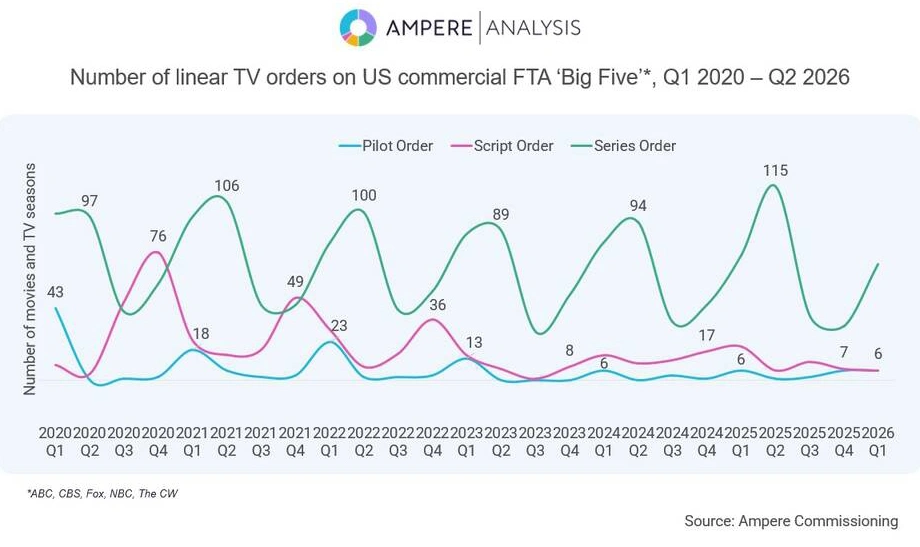





US linear TV is proving more resilient than streaming when it comes to new series orders, with broadcasters increasingly relying on established franchises and more flexible commissioning strategies, according to a new report from Ampere Analysis.
Ampere Analysis‘ report compares commissioning activity between 2022 and 2025 and finds that orders for US-produced linear content declined by 26%, from 1,773 to 1,304. Streaming orders, meanwhile, dropped 41%, falling from 1,144 to 678.
How Have US Linear TV Orders Changed?
The gap between broadcast and streaming becomes particularly clear in scripted television. Linear scripted series orders increased by 11% between 2023 and 2025, rising from 236 to 262.
Established franchises have played an important role in that stability. Broadcasters have continued to invest in recognizable titles with existing audiences, including long-running animated comedies such as The Simpsons and American Dad.
Free-to-air television has also performed better than pay TV. As pay-TV subscriptions have declined by 56% since 2016 amid the shift toward streaming, series orders from pay-TV providers fell 33% between 2022 and 2025, from 1,295 to 877.
By comparison, US free-to-air networks including NBC, ABC and CBS saw their series orders decrease by 13%, from 408 to 352 over the same period.
Why Are US Broadcasters Changing Their Commissioning Strategy?
The traditional US television development calendar is also undergoing a shift. Instead of concentrating scripted development around the end-of-year commissioning period and pilot orders in the first quarter, commercial free-to-air broadcasters are increasingly developing projects throughout the year.
Another notable change is the growing use of straight-to-series orders. Rather than putting every project through a pilot stage, networks are becoming more willing to commit to a full season from the outset.
According to Ampere Analysis senior researcher George Evans, this more responsive approach allows broadcast television to react more quickly to audience demand while making greater use of established franchises.
Are Networks Relying More on Existing Franchises?
The strategy is particularly visible in primetime scripted programming. Since 2024, 52% of new scripted series orders from US broadcast networks have been franchise-based.
The figure points to a more cautious commissioning environment, in which networks are prioritizing concepts that already have some level of audience recognition. At the same time, the move toward year-round development gives broadcasters greater flexibility in deciding when and what to order.
While streaming platforms continue to account for a significant share of global television spending, Ampere’s findings suggest that traditional US broadcasters are adapting rather than simply losing ground to streaming.
The changing balance between established franchises, straight-to-series commissions and year-round development could therefore become an increasingly important part of the US television business in the post-Peak TV era.