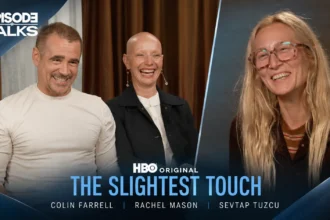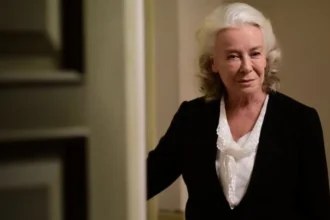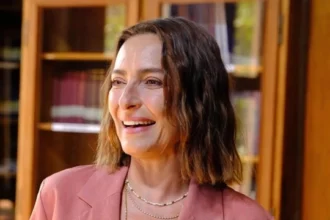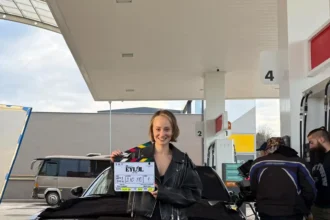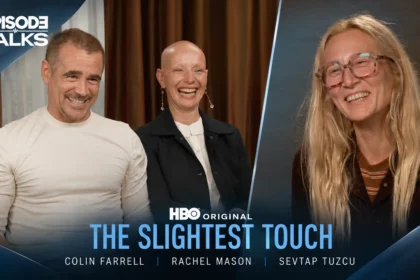





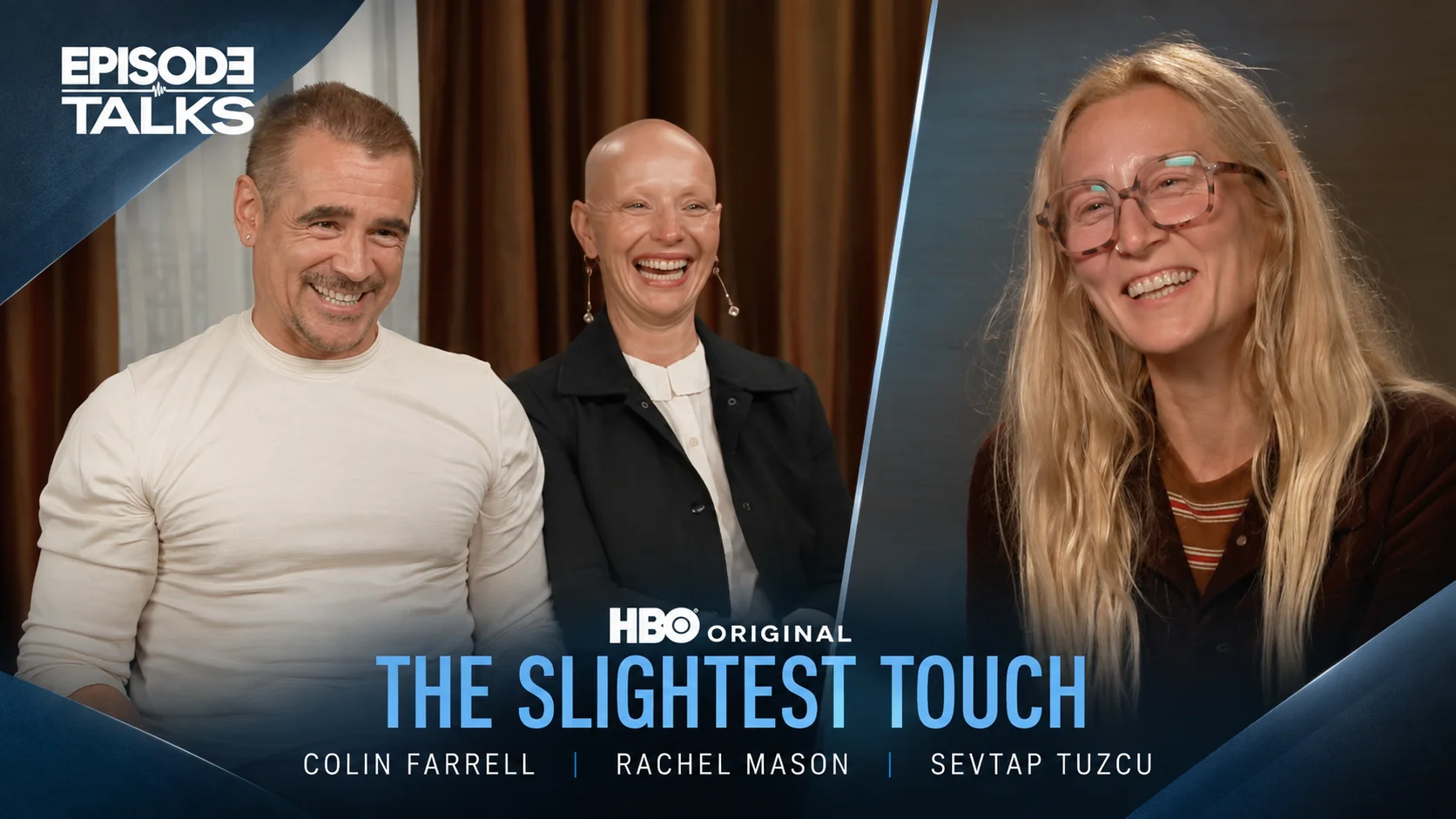
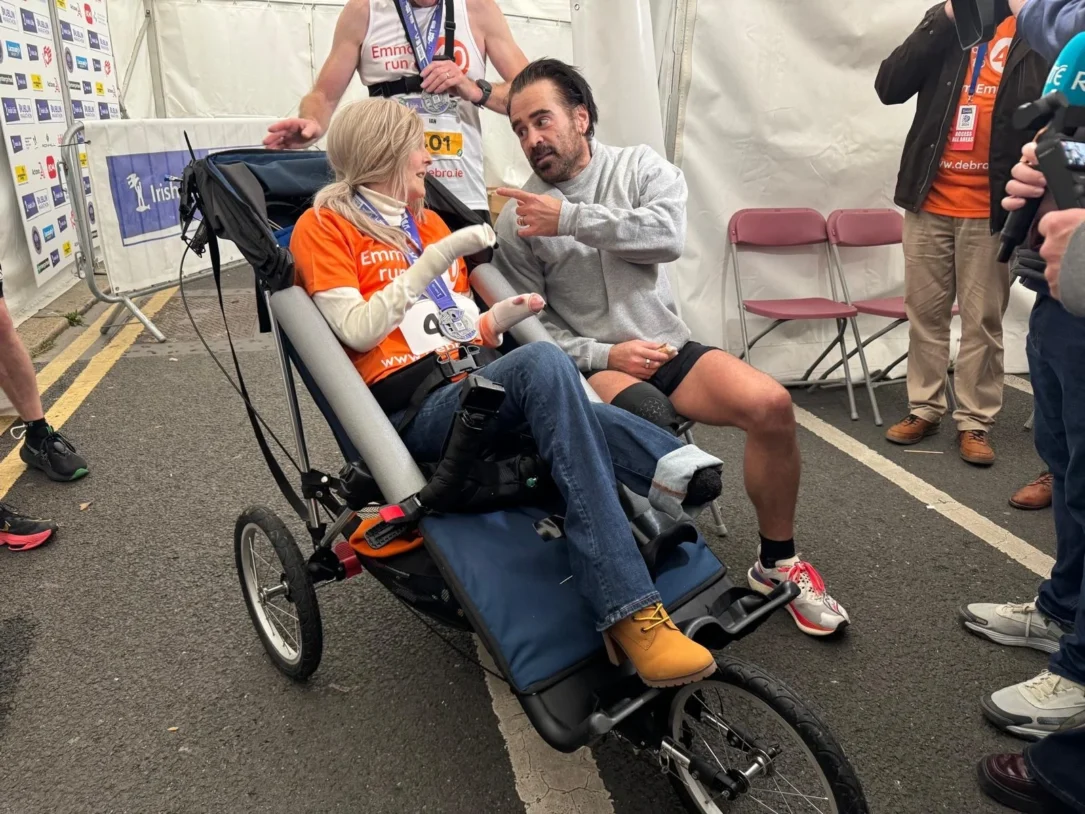
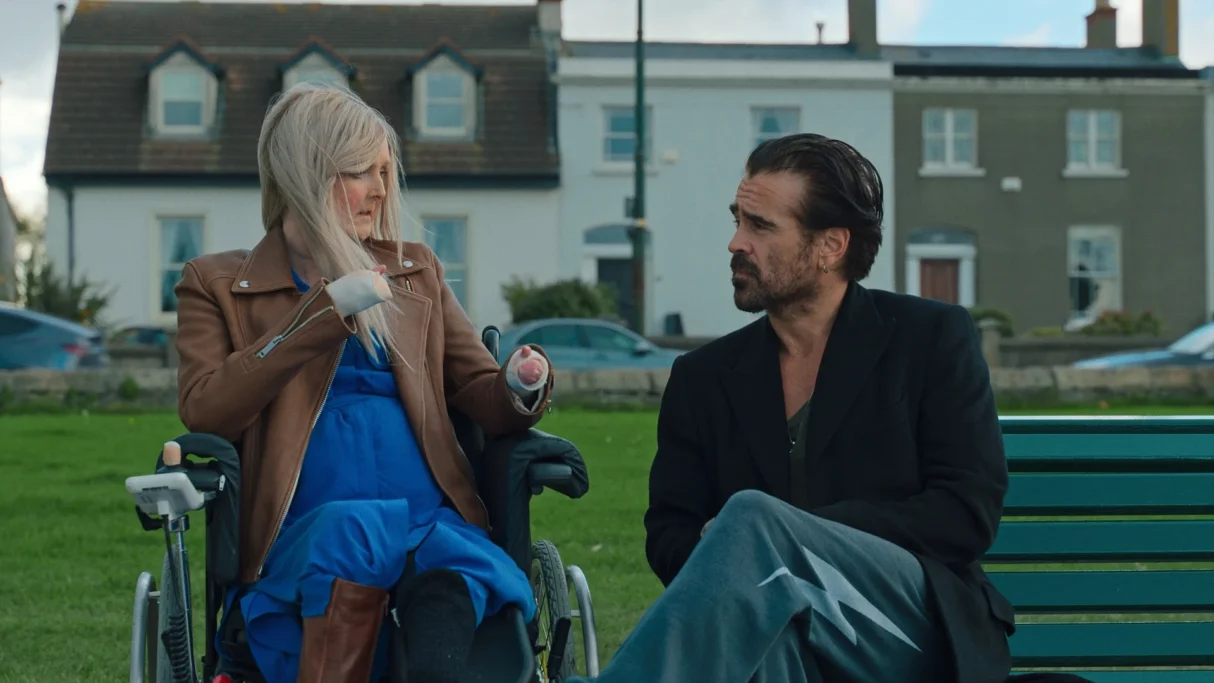
Colin Farrell, his friend Emma Fogarty, who lives with epidermolysis bullosa (EB), and director Rachel Fleit. Although what brings them together in The Slightest Touch may look like a marathon, the story is really about friendship, vulnerability and how we can be present in another person’s life. I met Farrell and Fleit in London. Like the film itself, our conversation moved beyond the boundaries of friendship and into our own lives.
- Everyone Said Fifteen Minutes. Rachel Saw a Film.
- A Father’s Story Opens Up to Another Father
- Emma Doesn’t Always Have to Be Strong
- Sometimes Friendship Is as Small as a Voice Message
- Loving Someone Doesn’t Mean Making Decisions for Them
- ‘The Slightest Touch’ Video Interview with Colin Farrell and Rachel Fleit
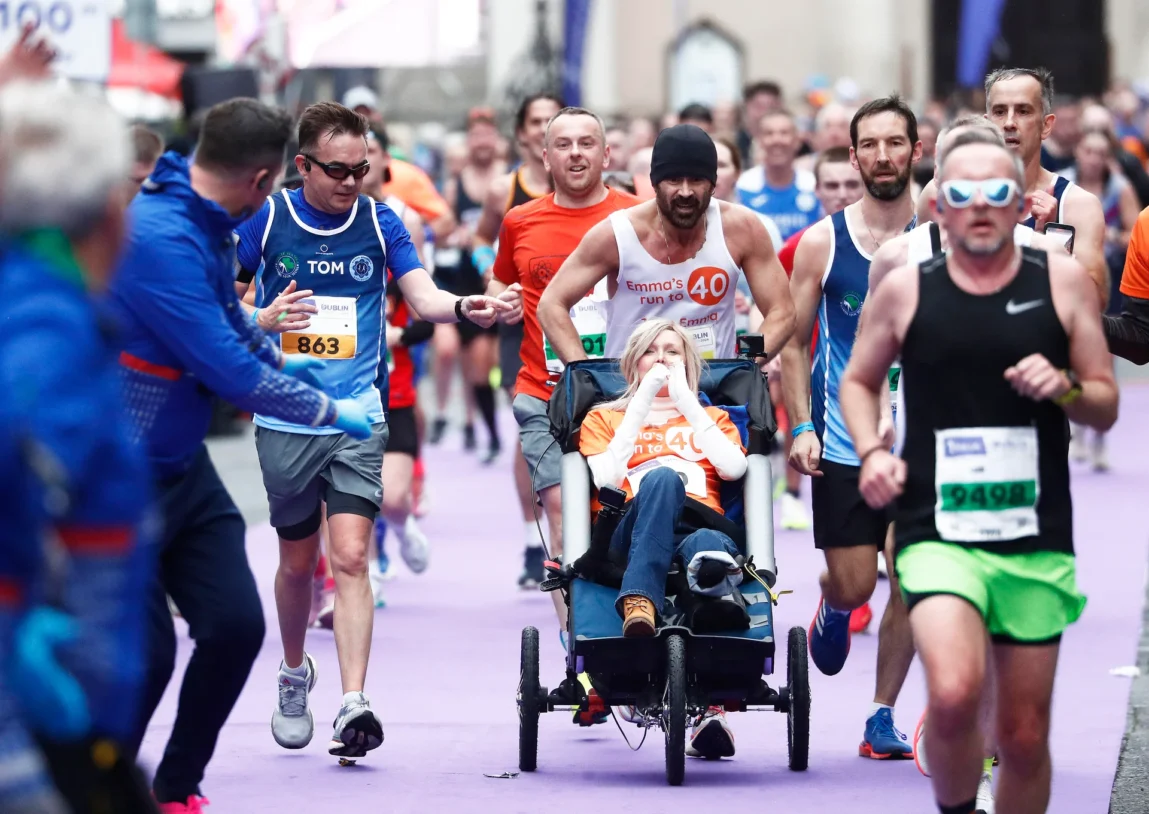
Doctors once told Emma Fogarty she would not live to see her 40th birthday. Emma, however, has decided to celebrate turning 40 by crossing the finish line of the Dublin Marathon.
When asked what her childhood dream was, her answer is brief: “Honestly, to prove everyone wrong.”
For the final four kilometres of the marathon, her 15-year friend Colin Farrell will push her wheelchair. The story is told through the lens of Rachel Fleit.
At first glance, this seems like an easy story to tell. A well-known Hollywood actor, his Irish friend living with a rare condition, and a marathon they have decided to complete together. It can be summed up in a few sentences, or easily turned into a feel-good story designed to move its audience. But The Slightest Touch steps beyond precisely this kind of easy narrative.
As the film unfolds, we begin to realise that the marathon is less a goal in itself than a space in which we can witness three people confronting their own lives.
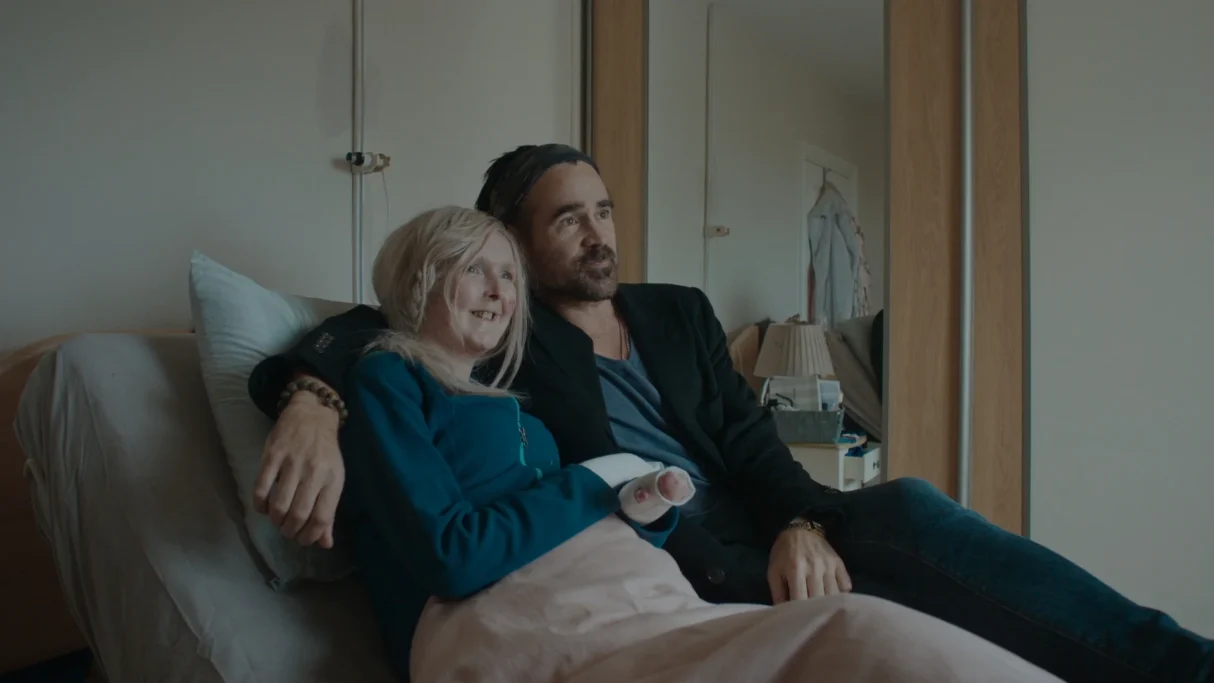
Emma’s skin is so fragile that even the slightest touch can cause an injury. Her days are filled with bandages, care routines and pain. As she grieves the life she has been unable to live, she does not give up on loving the life she has. Colin has built a different life for himself after years of addiction. Looking back at his past, he neither tries to downplay what happened nor define himself solely by those years.
Rachel, meanwhile, lives with alopecia universalis, an autoimmune condition that prevents hair growth across the body. Building a life in which she can feel at ease with her own body, independent of other people’s gazes, has also been a long journey for her.
There is no need to place these three experiences on the same level, nor would it be possible to do so. But there is something they share. People who have come to recognise their own vulnerability can sometimes approach the vulnerability of others with greater care, curiosity and less judgment.
That is what affects me most about the documentary. No one is anyone else’s saviour. Emma is not simply someone who needs protecting, Colin is not merely a friend offering help, and Rachel does not remain just the director documenting their story. They touch one another’s lives, learn from each other and, at times, change each other.
When the film’s release was announced, Farrell said he could not really think of The Slightest Touch as a film. For him, it was more like a collage of home videos made up of moments they had spent together. Watching it, I understand what he means. The camera is there, but no one is performing for it. Perhaps that is why we are allowed to witness a kind of intimacy we are not often accustomed to seeing.
I went to London with questions about friendship, trust and the responsibility that comes with entering another person’s life. When I returned, I found myself thinking about my own life, my friendships, my family and the relationships I have with the people I love. When I ask someone, “How are you?”, what am I really asking? And how ready am I to listen to the answer?
Everyone Said Fifteen Minutes. Rachel Saw a Film.
Emma was born with epidermolysis bullosa, commonly known as EB. This genetic condition makes her skin so fragile that even the slightest friction can cause wounds. As she prepares for the marathon with Colin, the pain, care routines and physical limitations that are already an inseparable part of her everyday life are joined by the challenges this experience may bring.
The idea of turning the two friends’ journey into a film came from Colin. He says he approached several people in the documentary world, but almost everyone gave him a similar response: there might be a 15- or 20-minute film here, but not enough material for a feature.
Because there was no pre-existing narrative. As Colin puts it, all they had was this: Her name is Emma, my name is Colin. She has EB, and I’m an actor living in Los Angeles with a bit of a problem with addiction.
Rachel, however, saw a film in that material. “No, we can make a film,” she said.
Before there was even a story, she believed it was worth pursuing.
Documentary audiences may know Rachel Fleit from two films. Her feature debut, Introducing, Selma Blair (2021), followed actor Selma Blair’s experiences after her MS diagnosis and her journey towards a risky stem cell treatment. The film received a Special Jury Recognition at SXSW. Bama Rush (2023), released on HBO Max, explored the sorority recruitment process at the University of Alabama, while occasionally turning the camera towards Fleit herself and her lifelong relationship with alopecia.
When Fleit first met Selma Blair, she says they immediately connected, partly because of her own experience with her body. A question she raised in relation to that film seems equally relevant here: I was born into this body, this is my life; can I accept myself?
When I met Rachel, I immediately felt close to her. My sibling also lives with alopecia, so I know something about the inner process of being seen without hair, of taking off a wig and allowing yourself to exist as you are. Seeing Rachel sitting across from me, beautiful in her own way and without concealing her hair loss, inspired affection and respect in me from the very beginning.
When I ask Colin when he realised he could trust Rachel, he does not hesitate for a second:
“Thirty seconds after we started talking.”
He then begins describing Rachel and does not seem particularly inclined to stop. “I love her head,” he says, “her whole being.” He compares her to a diamond. Her soul is just as precious, he says, speaking of her clarity, radiance, kindness and profound interest in other people.
This admiration for a director has a very tangible meaning. Opening the door to his home, allowing a camera to move around his children, and sharing his past and private life without holding anything back. As I listen to his answer, I begin to understand more clearly how the intimacy we see in the film became possible.
Rachel’s account of their meeting is much simpler. An email, followed by a few Zoom calls. She was in New York, Colin in Los Angeles. She first spoke to Colin, then to Emma, whom they refer to as the “big boss” of the team. Even through a screen, she could sense the connection between them. She knew they could embark on this journey together.
A Father’s Story Opens Up to Another Father
We see Colin in his Los Angeles home, looking at photographs of his sons. We are entering a level of intimacy he has not previously allowed the camera to approach so closely.
He shows a baby photograph of James. He says his son was still on a bottle at the time, then jokes that he himself was attached to another kind of bottle. I laugh, but I can also hear the embarrassment beneath the joke. I sense that the distance he has placed between himself and his past has been built not through denial, but through acceptance.
He says he gave up alcohol and drugs when his son was two and a half. One of the things he realised during rehabilitation was that his son needed a father, not a friend. There is a certain weight to this sentence, knowing that James, who lives with Angelman syndrome, will need support throughout his life. But there is also a kind of awakening in it. I see a father who has understood that he first needed to take responsibility for his own life in order to be there for his child. He cries as he speaks.
Then the story opens up to his own father.
Colin’s father lost his mother when he was a child. Following that loss, he had no space in which to talk about his feelings or make sense of his grief. “We are connected to all the generations before us through the deprivations they experienced,” Colin acknowledges.
During our conversation in London, he explains that as he gets older, the things that truly matter to him have become clearer. As the road behind us grows longer and the road ahead shorter, he says, we begin to look at life differently. This thought takes on even greater meaning when he talks about his relationship with his father. A man he once viewed primarily through his own needs and expectations has gradually become someone he can also see as a person who carried his own childhood, losses and deprivations.
Colin says his sons have raised him. Being their father has also helped him feel greater compassion for his own father.
This thought stays with me for a while. We often know our parents only through the roles they have played in our lives: our mother, our father, what they gave us and what they could not give us. It is not easy to remember that they were once children too, that they were afraid, that they needed things, and that perhaps no one ever comforted them.
This does not erase the things that hurt us in the past. Nor does it cancel out what was missing. But it gives us room to look at the story from another perspective. We inherit not only behaviours from our families, but silences as well. Love that no one knew how to express, pain that was never spoken about, closeness that was wanted but never received.
Recognising these things creates space for us to consider what we want to carry forward in our own relationships and what we might try to change.
This is where I appreciate Rachel’s storytelling the most. From the section in which Colin looks at himself both as a son and as a father, we move to Emma’s mother talking about her daughter’s childhood. One man’s perspective on his father opens up to another mother’s perspective on her child. Different faces of family life sit alongside one another without trying to explain each other.
Sometimes we hear Rachel’s calm, curious voice; at other times, we sense her presence simply through the way she places two scenes next to each other. Colin makes a similar point in the interview: the film is Rachel’s perspective from beginning to end. Because she has built such close relationships with the people she portrays, he has inevitably become part of the story himself.
Emma’s mother talks about her daughter learning to walk. She describes what those first steps meant to the family when they had been told Emma would never be able to walk. Years later, as we think about the finish line she wants to cross with Colin, that childhood memory takes on a completely different significance.
Emma Doesn’t Always Have to Be Strong
One of the things that stays with me most as I watch Emma is not the marathon goal, but her wish to feel the sand beneath her bare feet.
She has never been able to go into the sea. She has only been able to touch the water with the soles of her shoes, without getting her bandages and wounds wet. She loves the sea air and being at the beach. She does not hesitate to express her frustration when talking about the things she cannot do.
I find this incredibly valuable.
It is easy to admire the way other people live with pain. Especially when they love life, laugh and dream, we can quickly turn their stories into sources of inspiration. But Emma wants the life she has been unable to live just as much as she loves the life she does have. She grieves for it. Some days, she is exhausted.
And she has every right to say so.
As we watch her, we realise that we cannot expect her to be constantly strong, cheerful and grateful.
There is a phone conversation between Colin and Emma. He tells her not to accuse herself of complaining or feeling sorry for herself. He encourages her to be a little kinder to herself and to approach her feelings with compassion. He says this is one of the things he has learned through twenty years of therapy.
It is clear how closely Colin’s advice to Emma is connected to his own life. We hear someone who has examined his addiction, fatherhood, past and regrets, and who has found a way to be at peace with himself. Someone who understands that trying to understand yourself is different from constantly judging yourself.
Sometimes we forget that compassion is not simply kindness directed towards another person. We also have to allow ourselves the same right.
There is also the question of how easily we pass judgment on other people’s lives: How do they endure it? How can anyone live like that? I could never do it. Colin talks about the comments people make when looking at Emma’s life from the outside, and how he has learned to question his own initial reactions.
Perhaps getting to know someone truly also requires us to let go of our first judgment about their life.
What’s more, Emma and Colin have a lot of fun together. They tease each other, make fun of themselves and, in a way, become children together. In the scene where they first try out the marathon wheelchair, Andrew Bird’s “Sisyphus” plays in the background. I cannot help drawing a connection between Colin pushing the chair and Sisyphus’s endless struggle. Yet the light rhythm of the music and their laughter playfully counter that heavy image. The effort remains, but the way they experience it seems to lighten its weight. These are precisely the moments when I love Rachel’s storytelling.
Just because there is pain in our lives does not mean every moment has to be solemn and tragic.
Immediately afterwards, Emma gets behind the wheel and Colin gets into her car. They joke about the seat belt. Just moments earlier, Emma had entrusted her movement to Colin; now Colin is her passenger.
The reciprocity of friendship is felt in a matter of minutes, without the need for lengthy explanations.
Sometimes Friendship Is as Small as a Voice Message
This closeness can also withstand distance.
Colin is in Macau for the filming of Ballad of a Small Player, while Emma is in Abbeyleix. On one side are the seemingly glamorous, brightly lit and inviting streets of Macau; on the other, grey, rainy but authentic Ireland. Different time zones, different everyday lives. Between them are messages, FaceTime calls and a shared goal they want to achieve together.
When I ask Rachel how the process affected her emotionally, she says she found herself thinking about Colin and Emma’s friendship throughout the film.
Watching them also held up a mirror to her own friendships.
How am I present in people’s lives? Am I doing the best I can? When I cannot be physically there for someone, how can I be there for them emotionally?
She says she has started thinking more about the importance of a small message, a voice recording or an unexpected phone call sent to a friend having a difficult day. She also says Emma has a way of bringing people into the present moment. Rather than constantly calculating the future, Emma encourages us to stay within the day we are living and experience it as it comes.
As I listen to Rachel, I find myself thinking about my own life.
There are many times when I think about someone and let the day end without telling them. There are also times when I do not call because I do not have time for a long conversation. Sometimes we wait for a big stretch of time, the right moment or an extended get-together to do justice to our friendships. Yet there are much smaller ways of being present in someone’s life.
Sending a voice message. Seeing something that reminds you of someone and sharing it with them. Asking how they are, but doing so when you genuinely have the time to listen to the answer. Being able to stay with someone when a conversation takes a difficult turn, without immediately trying to come up with a solution.
Perhaps what defines friendship is not so much the length of time we spend together as how present we are during that time.
Colin also tells me in our conversation that having people you can trust, and knowing that others trust you, is a very important part of being human. He says he has come to appreciate the beauty of this more as he has grown older.
When we are young, I suppose we see friendship as something more spontaneous, an already established part of life. As time passes, we realise that maintaining it and remaining part of someone’s life also require effort. Sometimes it is not grand sacrifices that matter, but small, consistent acts of attention.
And sometimes knowing that someone trusts us can be just as transformative as trusting them.
Loving Someone Doesn’t Mean Making Decisions for Them
Emma’s decision to run the marathon raises another question within all this closeness: How far do we restrict the lives of the people we love when we are trying to protect them?
Her family is worried. Colin also knows how much Emma may suffer physically after the marathon. But he does not make the decision on her behalf.
When we discuss this in London, Colin’s words affect me deeply.
He is particularly careful to emphasise that he would never compare any pain he has experienced with the pain Emma lives with every day. He says he does not know how much Emma will struggle after the marathon, and that it could be extremely difficult. Then he gets to the heart of the matter: This is Emma’s life. This is her choice. And he is now part of that choice too.
Emma does not deserve the pain she will experience afterwards, but she deserves to have that experience. And sometimes it is impossible to have one without the other.
This thought extends beyond the boundaries of the film.
Wanting to protect someone we love is deeply human, especially when we know they could get hurt. But the line between protecting someone and controlling them can sometimes be very thin. Loving another person does not give us the right to decide what they consider worth experiencing.
This is one of the most meaningful aspects of Emma’s decision. She is not simply someone living with what has happened to her; she is also someone who decides what she wants to happen in her life.
The film does not conceal the cost of that decision. It allows Emma to say when she is struggling and does not soften her experiences for the sake of a beautiful story. I think that is where its sincerity lies. Being grateful to someone while expressing exhaustion, feeling happy about an experience while also talking about its pain.
Sometimes the most important thing a good friend can do is stand beside us without making decisions on our behalf.
Colin laughs as he describes the filming process. He says that Rachel, as the person telling the story, was always supposed to remain somewhat on the outside, but he did not have that kind of concern.
“I was just a victim of the whole process,” he jokes.
He did not think about what should or should not happen. “Do you want to talk today? Okay. The camera is there. Let’s talk.” That was all.
For him, even though the journey sometimes led to the most intimate corners of his own life, this experience was simply an extension of his friendship with Emma.
But now, as they talk about the film, he says he has found himself reconsidering that friendship too. Trust, being present in someone’s life, and the value of having been given a place in other people’s lives.
Perhaps turning the time they spent together into a film has allowed them to look at a bond that had already existed for years from a different perspective.
Rachel’s camera does exactly that. It lingers a little longer on things that seem ordinary and often pass unnoticed. A look, a joke, a voice on the phone, one person waiting for another.
It makes visible the small moments that might otherwise disappear into everyday life.
◆
The title The Slightest Touch touches me in two ways. It refers both to Emma’s body, which can be injured by the slightest touch, and to the space that even the smallest gesture can open up in another person’s life.
A message, a well-timed joke, a question asked and an answer genuinely awaited. None of these things can erase Emma’s pain. But they can make room in her life for joy, closeness and things to look forward to with excitement.
I also recommend this film for the questions viewers can take back into their own lives. How am I present for my friends? Do I really listen to the people I love? Am I able to show myself the same understanding I offer others?
Thinking about the film and our conversation in London, these are the questions that stay with me the most. The story reaches out to those caught up in their own struggles, those who sometimes cannot find the strength to lift their heads, and those trying to understand their relationships with themselves and others.
To those who reach out, and those who are not afraid to be touched.