




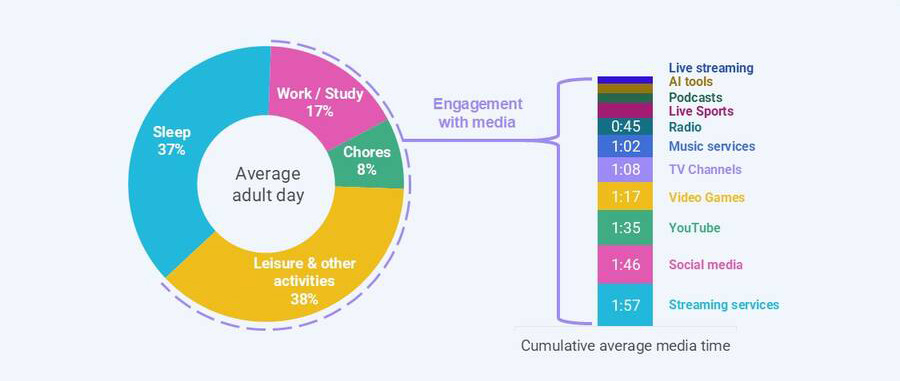
Consumers in the UK and the US now spend almost 11 cumulative hours per day engaging with media, according to a new report from Ampere Analysis, highlighting how streaming services, social media, gaming and digital platforms continue to compete for increasingly fragmented audience attention.
The firm’s latest Attention Economy study found that adults use an average of 11.5 different media platforms every week, illustrating that audiences are no longer loyal to a single service but instead switch between multiple platforms depending on their mood, location and entertainment needs.
Streaming remains the largest category for daily engagement, with audiences spending an average of 1 hour and 57 minutes per day on subscription video services. Social media follows at 1 hour and 46 minutes, while YouTube accounts for 1 hour and 35 minutes of daily consumption.
The report notes that the nearly 11-hour figure includes simultaneous media use, such as watching television or streaming content while browsing on a smartphone. This multi-screen behavior has significantly expanded the amount of media consumers engage with throughout the day, intensifying competition across streaming, social media, gaming and music services.
Rather than competing solely on viewing time, different platforms now serve distinct consumer needs. Streaming platforms are primarily associated with relaxation and immersive viewing experiences, while YouTube is more commonly used for discovery and mood enhancement. Social media, meanwhile, is often the platform of choice for relieving boredom or filling spare moments.
Generational differences also continue to shape viewing habits. Gen Alpha audiences (ages 11–15) spend the most time on YouTube and gaming, averaging 1 hour and 45 minutes and 1 hour and 56 minutes per day, respectively. Gen Z consumers (ages 16–29) devote the most time to social media, with an average of 1 hour and 54 minutes daily, alongside 1 hour and 20 minutes spent on music streaming services.
Older audiences display different preferences, with Generation X and Baby Boomers dedicating a larger share of their media consumption to streaming services, traditional television channels and live sports.
Platform diversity is also highest among younger viewers. Gen Alpha accesses an average of 13.6 media services each week, making it the broadest media portfolio of any demographic surveyed. Across all age groups, streaming platforms such as Netflix and Disney+ account for an average of 4.1 services within consumers’ weekly media mix.
The research also highlights the growing role of mobile devices in premium streaming consumption. More than 28% of Netflix users in the UK and the US regularly watch the service on their smartphones, while mobile listening continues to drive music streaming outside the home.
Background viewing is becoming another increasingly important part of the attention economy. According to Ampere, 33% of YouTube users say they use the platform simply because they “want something on in the background,” demonstrating that platforms are increasingly competing not only for focused viewing but also for ambient attention throughout the day.
Commenting on the findings, Ampere Analysis Research Manager Sam Nursall said today’s consumers are assembling more varied media diets than ever before, choosing different platforms depending on what they want at a given moment.
For media companies, broadcasters and streaming services, the report suggests that success will increasingly depend not only on attracting audiences, but on understanding the different contexts in which consumers choose to spend their attention.