




Eda Akça reviewed Calinos Entertainment‘s series Salted Love.
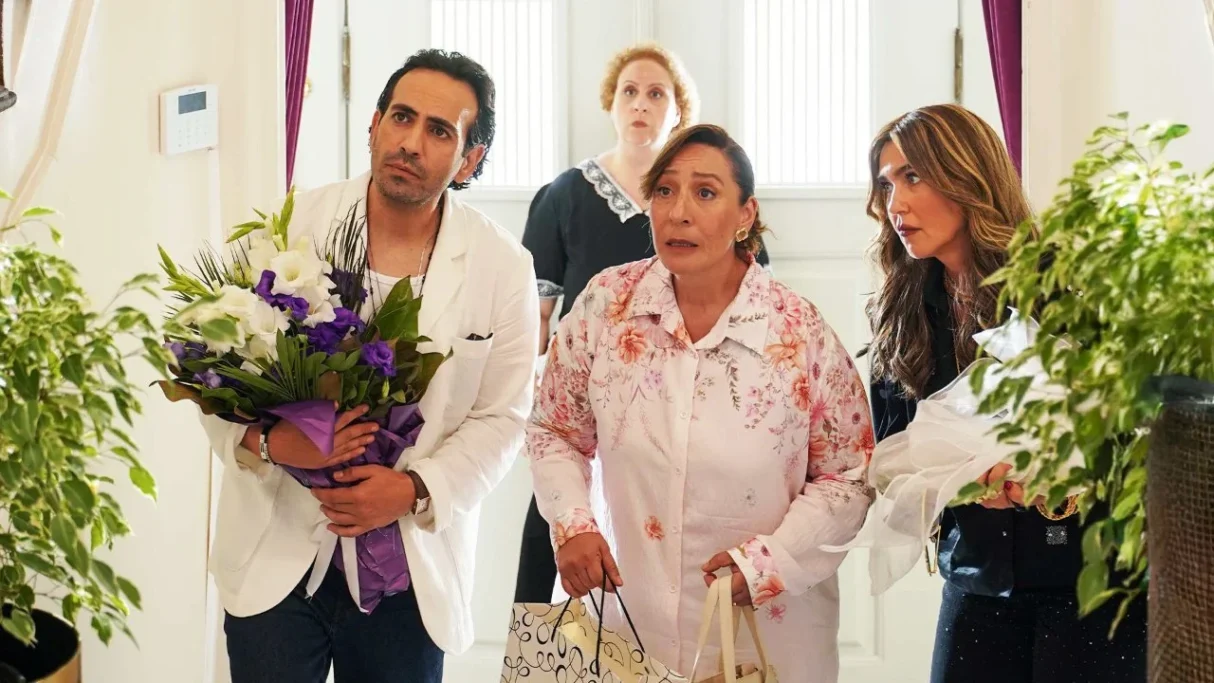
Do the shapes that appear in a coffee cup reveal the future, or do we simply see at the bottom of the cup what we want to see? In the first episode of Salted Love, a cup is turned upside down with Mehmet in mind, and the first signs to emerge are love, followed by a ring. Those reading the fortune interpret these signs as pointing towards the bride-to-be they have already chosen for him, but the real ring in this story belongs to Derin.
After discovering that the man who proposed to her has been cheating on her, Derin throws her engagement ring into the sea, casting away not only her relationship but, in a way, the life that has been mapped out for her. Unable to let go of her expensive ring, she dives in after it. Mehmet, mistaking her actions for a suicide attempt, rushes to save her, only to become the one in need of rescuing. The promise of love foretold by the coffee grounds and the fear stirred by a dream from years ago converge in the same waters.
With this first encounter, Salted Love establishes a world governed less by coincidence than by fate, bringing Derin and Mehmet together through fortunes, dreams and omens.
Is Marriage a Matter of Two People?
As many of us know, Turkish coffee with salt is traditionally served to the groom after the groom’s family asks the bride’s family for their permission to marry their children. With the coffee, the groom’s patience and affection are put to a playful test. In the series, however, the tradition becomes a contest in which families test one another. Before Derin and Mehmet have even met properly, everyone around them already has a plan for their lives. The series’ central concern, then, is less the romantic encounter itself than the question: “Do we really get to decide whom we marry and when?”
Derin’s greatest wish is to get married and start a family. Yet the first episode deliberately leaves it unclear whether this desire stems from her own free will or from the expectations her family has placed on her over the years. Following the end of her relationship with Hakan, the man she was about to marry, after his betrayal, Derin’s real journey seems set to involve more than finding another man to marry. It will be about discovering the difference between her desire to get married and the life she truly wants.
Mehmet represents the other side of this pressure. Despite having established his own life abroad, he is drawn straight into his mother’s marriage plans as soon as he returns to Türkiye. The series thus places a woman and a man on opposite sides of the same social expectation. Derin is pressured because she cannot seem to get married, while Mehmet is pressured because he does not want to. This contrast provides fertile ground for the attraction that will develop between them.

Three Families, Three Different Coffees
Behind the pressure to marry that weighs on Derin and Mehmet are three families, each with its own distinct dynamics. Coffee is not just part of the series’ title; it is also woven into the characters’ everyday lives. With their different habits, histories and atmospheres, each family resembles a different kind of coffee: the Kutays prefer theirs sweet, the İpeklis take theirs plain and full of grounds, while the Aydınoğlus favour theirs with plenty of froth, always on the verge of boiling over. As Derin and Mehmet grow closer, their relationship will mean more than two people getting to know each other. The bond they form will inevitably bring these three very different families to the same table.
The Kutay family is a household dominated by women, where several generations live together. Having lost her mother at a young age, Derin grew up with her grandmother, Sitare, her aunt Tiraje and her uncle Taylan. Her desire to marry and start a family of her own takes on a deeper meaning in light of her mother’s absence and her long-standing longing for a family life of her own. From this perspective, marriage is not simply a romantic happy ending for Derin; it is an attempt to fill a void she has felt since childhood.
The İpekli family, meanwhile, represents the darker side lurking beneath the series’ colourful, lively world. At its centre is Feryal, whose authority over the household is immediately apparent. Including Elit and Ünver, the family appears more reserved and distant than the others. Its long-standing hostility towards the Kutays shifts the tone of the comedy whenever the two families come face to face.
As for the Aydınoğlus, their Adana roots, domestic rituals and crowded household, where everyone directly intervenes in one another’s lives, paint a more traditional family portrait. Because everyone is so closely attached to everyone else, no one’s life truly belongs to them alone. Hatun, in particular, frequently crosses the line between her love for her eldest son, Mehmet, and her desire to control his life.

A Return to Comedy
Given that mainstream television has long been dominated by heavy drama, major family secrets, violence and seemingly endless vendettas, Salted Love making room for comedy is significant in itself. Once a staple of television, comedy has gradually become less common on screen, while audiences’ longing for warm, everyday stories that can be enjoyed together has grown over the years. Salted Love seeks to fill precisely this gap, offering viewers a chance to breathe amid the darker stories that dominate the screen.
One of the series’ greatest strengths in pursuing this ambition is its cast, which brings together actors who have left their mark on different eras of Turkish television. Uniting performers from different generations in a single story, the ensemble emerges as one of Salted Love‘s biggest promises from the very first episode.
Moreover, the series draws not only on the cast’s present-day performances but also on the memorable roles these actors have left in viewers’ memories. Familiar faces from the worlds of characters they portrayed in the past appear as guest performers, while verbal references woven into the episodes create a playful sense of nostalgia. By bringing together actors we once watched side by side in entirely different stories, the series allows its scenes to reach beyond the world of Salted Love, transporting viewers, if only for a moment, back to those earlier shows and characters. This is another testament to the strength of the cast and the richness of its collective television legacy.
In this way, while telling a new story on screen, the series also carries the warmth of a familiar world. At the heart of that warmth are three families, each with its own distinct flavour. Perhaps what will finally bring them all to the same table is the salted coffee brewed for Derin and Mehmet.
This time, however, there is no single groom who must prove his love by drinking the coffee. The real test awaits three families, all of whom must learn to leave their prejudices behind.